

Reifegrad-Modelle
A blog by Dr. Uwe-Klaus Jarosch, April 2026
Product Development:
It’s simple:
Have an idea – Test it – Offer it – Done.
For craftsmen, this might be how things are done in some cases and it might work well.
However, when we’re talking about industrial products—that is, products with a larger customer base and repetitive manufacturing—both the development of the product itself and the planning and preparation for production will require an organized process.
That’s why this blog post will focus on the design and use of a maturity model for the product development process.
Why do we talk about maturity levels?
In the run of a development process from idea to finished product in series production, important decisions must be made within the company.
Here is a list without claim to be complete:
- This product idea is to be developed into a product.
- We submit a quote at a customer’s request.
- The product design is ready enough that prototype build for testing can begin.
- The prototypes have passed functional tests. Equipment and tools for mass production must be ordered.
- Production volumes must be planned, including parts supply and logistics.
- Equipment and tools are available. The quality of the pre-series parts produced determines whether product and process development is complete and mass production can begin.
- Delivery of the first products to customers.
- Decision to ramp up production to the planned volume.
- Expansion or modification of production capacities.
- Modification and/or further development of the product.
These or similar decision points can be highlighted as milestones or decision points in a project.
Each milestone in the sequence represents progress in the product’s maturity.
Such a maturity model should be in the interest of every company involved in development.
In some industries, such as the automotive industry, such maturity models have been developed by OEMs[1]. The OEMs apply these maturity models to their own development and require their suppliers to develop according to this or a recognized comparable model as well.
[1]OEM = Original Equipment Manufacturer. Such companies have the responsibility towards the final customer even if numerous components come from subsuppliers.
For German automotive manufacturers, there is an industry-specific description of maturity models available from the VDA QMC[2]. In the U.S., the APQP[3] process is comparable to this.
[2] See Reifegradabsicherung für Neuteile_06/2022-Verband der Automobilindustrie e.V. Qualitäts Management Center (VDA QMC)
Which Model for Whom?
The term “model” implies that it is a framework designed to simplify development processes.
However, in my view, that is not the case. Therefore, I also believe the term is incorrect. I consider terms such as “maturity assessment system” or “milestone system” to be more appropriate.
The process of developing products and processes is not influenced by the maturity model. This PDP[4] will be tailored to the specific company or product, focusing on what the company deems necessary to achieve mass production. For a software company, this is significantly different from a firm that operates as a contract manufacturer.
[4] PDP = „Product Development Process“
But in every company, all or some of the questions I listed at the beginning will need to be addressed to a greater or lesser extent.
Preparation is necessary for each of these decision points. Various departments and roles within the company will be able to—and must—make a clearly defined contribution to these decisions.
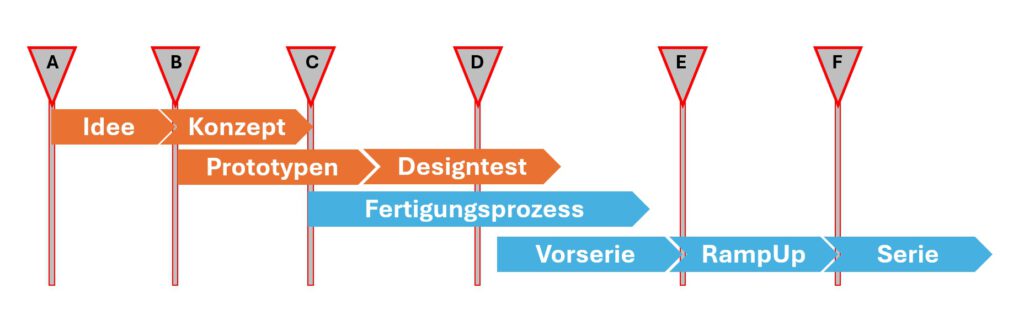
In a maturity model or milestone system, a series of questions must therefore be answered for each milestone:
- Does this milestone occur in our business model / in this project?
- If so, at what point in the project must this milestone be decided in order to complete the project on time? This will usually require working backward from the target date and estimating how long all intermediate steps will take.
- What exactly is the decision to be made at this milestone? Are there any comparable decisions that must be staggered throughout the project, i.e., made at different points in time?[5] How is this handled?
[5] Ordering of equipment and tools may strongly differ from part to part depending on the lead time for design, delivery and set up. - What information must be available, and to what standard, in order to make the decision with the lowest possible risk of making a wrong decision?
- What is the typical response if the milestone cannot be decided upon in a timely manner?
There is no one-size-fits-all answer to these questions for an entire industry. Each company needs its own tailored system for this.
Frameworks such as the VDA Maturity Model, APQP, the V-Model, and similar standards can provide a proposal for this and contain a relevant collection of questions that must be considered.
When a customer asks whether the supplier company follows a maturity model based on a particular standard, the answer will consist of two parts:
- Yes, we generally have a milestone system in place to systematically track our PEP or
No, we haven’t needed that so far. - Our system differs from the standard in question in the following ways:…..
Whether a milestone system or maturity model within the company actually leads to projects being completed on time, budgets being adhered to, and results being available in time for the milestones depends, on the one hand, on whether targets can be realistically achieved with the available knowledge and resources, whether the development control loop functions properly, and whether management maintains a functioning system of reporting, escalation, and decision-making.
In summary: Achieving a project’s maturity level according to plan is primarily a leadership task.
In a project, 1.) things always turn out differently than 2.) you expect.
Conclusions:
- Not every company needs a milestone or maturity model. But some industries demand and require it.
- Those who develop and produce products or services in large quantities should be able to manage the maturity level within the projects.
- Companies with complicated or even complex products and an organization with specialized departments need rules for decision-making.
- Every company needs its own individual system, regardless how it is named.
- Milestones will not beware management from having to make decisions even when not all desired information is available.
- Standards such as VDA, AIAG, and the V-Model provide important criteria.
- The control loop for development is and remains a leadership task.
Stay curious
Yours
Uwe Jarosch