
Problem-Solving - What is the Problem ?
The difference between problem, symptom, and cause
A blog post by Dr. Uwe-Klaus Jarosch, February 2026
In this series of blog posts, I began with the Ishikawa diagram, probably the best-known method for determining causes.
Its approach of brainstorming potential causes in a group raises some reservations, which can be summarized as a lack of systematicity.
The Keppner-Tregoe method for example is much more systematic in finding the set of causes that describes a problem as completely as possible.
In all of this, one central question has not yet been addressed: When do we speak of a problem, and when of a symptom? What, in contrast, is a cause? And when do we speak of a root cause?
This article is dedicated to these questions. Main parts are taken from the book “Advanced Planning – Step by Step from Idea to Product,” Appendix 9.1 (in German).
An essential element in solving a problem is first of all to recognize the problem.
In the usual procedures, material is initially collected, sorted, and, if necessary, researched using a systematic questionnaire, e.g. by a Is – Is Not table.
But the person or team faced with such a pile of information is helped by criteria that can be used to sort the information.
Basically, it helps to put causes and effects into a logical sequence. It becomes difficult with chicken-and-egg constellations, which can be arranged as cause and effect in one way or another. In such cases, it helps to examine the chronological sequence of events specifically for the case in question.
However, a second aspect is also crucial for problem-solving approaches: Where in the chain of events, where in the chain of effects and their causes, is the problem located?
To determine this, the image of a staircase is useful.
Each step is a cause-and-effect relationship, with the effect at the top and the causes on the next step below.
Whenever there is another step between the observation of the internal or external customer and its cause, you are describing a symptom. This symptom is observed, but it cannot be eliminated at this point. The problem lies deeper.
If there is a clear, direct, and unbranched chain from the observed symptoms of your customer to the root of the problem, then you are fortunate in that it is a trivial phenomenon. On the other hand, there is actually no problem, no ambiguity that needs to be resolved. Only a clear root cause needs to be controlled.
In real situations, you will find that there will be multiple effects, multiple symptoms, and multiple possible explanations and causes.
The problem can be located at the point where the symptom paths coming from above meet and then diverge again in different directions. The problem is that at this point it is not yet known or clear which possible path or paths are really the cause.
This is illustrated with the problem staircase.
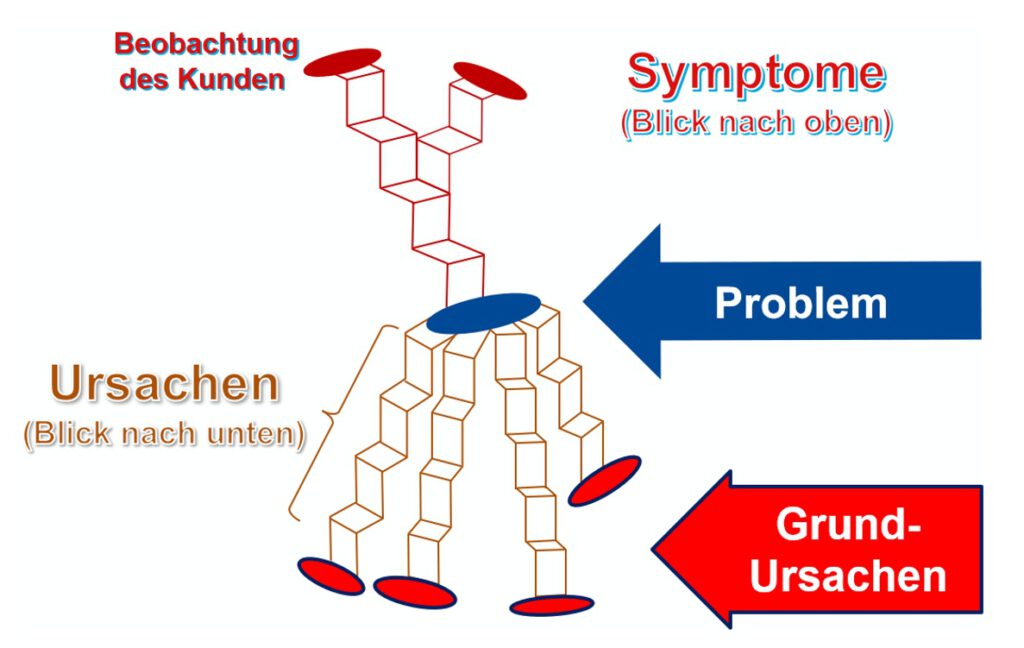
The cause analysis starts with the problem and begins with the most precise description of the problem possible.
Methods such as the Ishikawa diagram, 5xWhy, or the Is-IsNot method are used to find causes that have an arguable cause-and-effect relationship to the problem.
To solve the problem, the approach is to prevent the causes. This principle underlies the FMEA method, for example.
With numerous cause-and-effect chains, one can continue to ask “why” on and on. However, the solution to a problem is not achieved by an analysis of arbitrary depth. A problem can only be solved to the extent that the team can influence it. This means that the “why” chain ends at the points where the team or the company can set and enforce rules or parameters.
These points are the root causes of the problem and the starting points for measures.
Conclusions:
- A lack of customer observation is not the same as the problem that the distributor has to solve.
- The description can be used as a problem when the causes are unclear.
- Solving the problem involves several steps. However, step 1 is always to clarify the root causes.
- A root cause must lie within the area of responsibility of the team or the company. Further deepening and opening new branches cannot provide a solution.
Stay curious
Yours
Uwe Jarosch