
Problem-Solving - Root Cause Analysis via Is-IsNot Procedure (Keppner-Tregoe)
A blog post by Dr. Uwe-Klaus Jarosch, February 2026
One of the 7 quality standard (core) tools is the Ishikawa diagram.
This graphical method has been invented by the Japanese engineer Kaoru Ishikawa in 1943. His intention was to give a structure and promote visibility of causes of a quality problem, and to prevent to work mainly on symptoms.
The design of the diagram – similar to the bones of a fish – has given the popular name of the “fish bone diagram”.
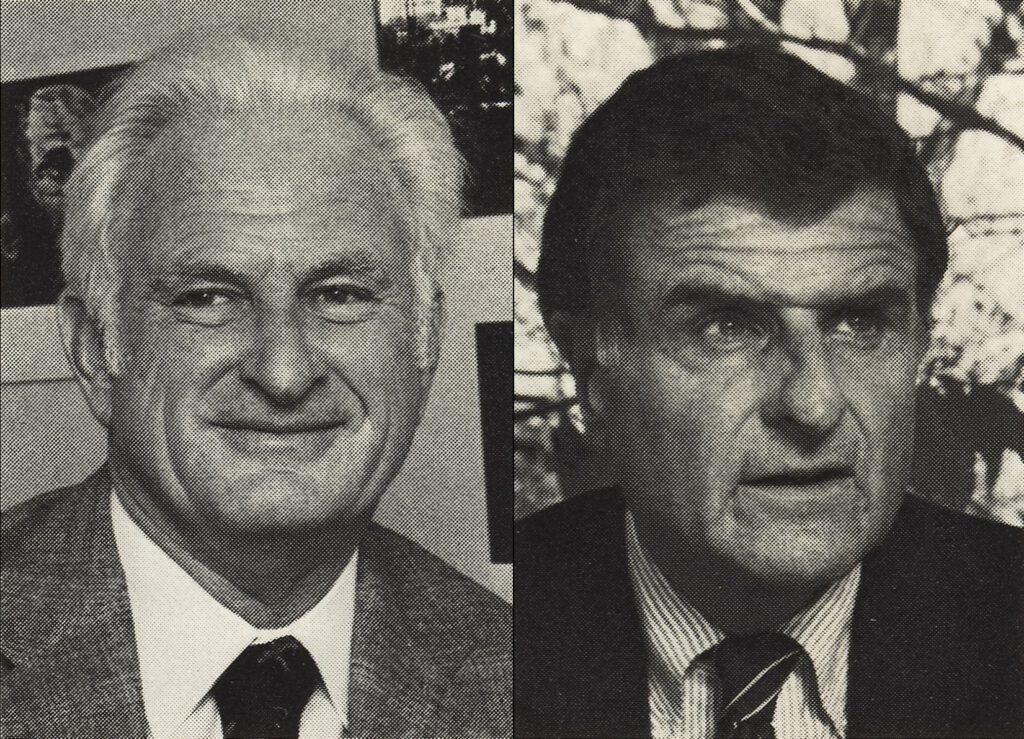
In the late 1950s, the two social scientists developed a logically consistent method for solving technical problems in the USA.
After the first step of the method, the procedure also became known as “Is-IsNot.”[1]
[1] Jointly with a decision finding approach and a type of business management system the problem solving procedure is prescribed in detail in the book “The Rational Manager”. My top tip!
Methodologically, the content development is linked to a 4-step work plan:
- Is-IsNot fact gathering
- Identify differences and deviations
- Presumed causes – create hypotheses
- Elimination process for hypotheses – before, after
Step 1 Is-IsNot fact gathering
Step 1 uses a table as a checklist: All details that the team should be aware of are systematically queried.
- WHAT – what is the object, what is the problem?
- WHERE – observed on the object, where first, where last observed?
- WHEN – first observed, when last observed?
- HOW MANY – how many objects are affected? Extent of the error? How many errors per object? What has been the trend so far?
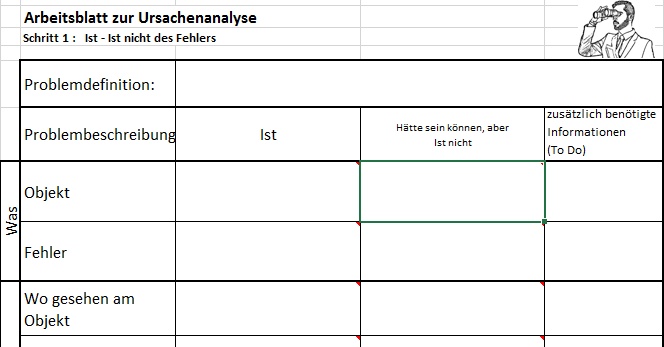
The following is collected for each of the individual questions:
- The direct answer to the question,
- What, where, when, how many – could be, but is not,
- What, where, when, how many – still to be clarified?
Every field must be filled in without exception.
Step 2 Determine Differences and Deviations
The method assumes that there was a previous state in which the given problem did not yet exist. It therefore makes sense to compare the state without the problem with the current state with the problem.
Here, too, a systematic analysis is carried out.
The method uses the 6 or 7 Ms that are also typical for Ishikawa analysis: Man, Machine, Material, Environment, Method, Management, Measurement.
Four questions are asked for each category:
- What is different from before?
- And Why?
- What is unique, striking, remarkable?
- Why?
In addition, in cases of doubt, the question is asked: What is true/proven?
If there are a large number of differences in a category, they are prioritized. Only the five most important ones are considered further.
Step 3 Presumed Causes – Hypotheses
Step 3 uses all the information collected to formulate hypotheses about the presumed causes.
In contrast to other problem-solving methods, the search for causes is started at a late stage of the procedure. It is not about wishes or brainstorming, but about fact-based arguments.
In the case of complicated problems, several causes in a logical interaction must be taken into account and together form the hypothesis of what is causing the problem.
Several hypotheses may seem plausible, and in step 3 of the process it is not yet possible to decide which one is really correct.
Step 4 Exclusion Process for Hypotheses
In step 4, the collected facts are shown again. All entries in the seven categories, both “is” and “is not,” must be explainable by the hypothesis without contradiction. Otherwise, the hypothesis is incorrect or at least incomplete.
Of course, the hypothesis can be revised and re-examined at this point.
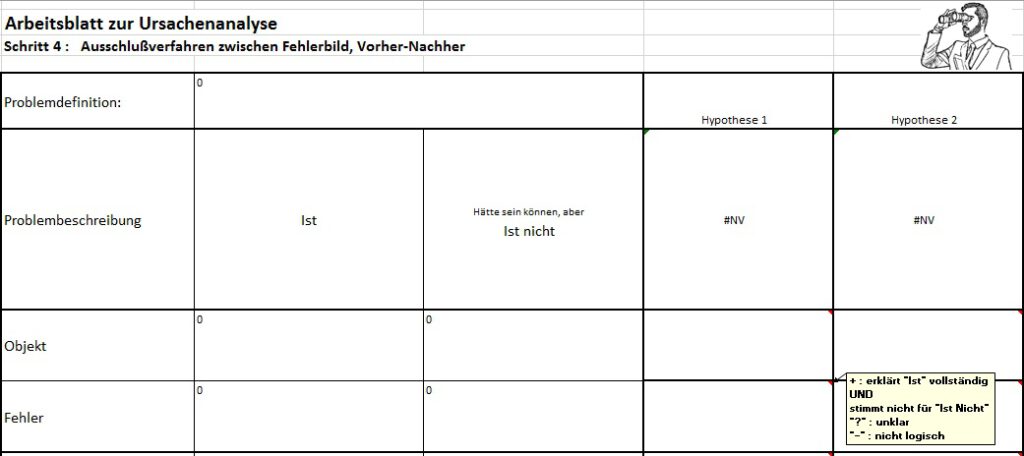
As long as not all observations from the first two steps can be explained by the hypothesis and the assumed causes, at least the complete clarification of the problem is still pending. However, that is the goal of this procedure.
Pros & Cons
One argument in favor of this procedure is that it uses systematic analysis in all steps and is therefore consistent in its results.
However, the effort required should not be underestimated.
For the “problem owner,” it involves a comprehensive examination of all aspects and requires all categories to be substantiated with facts.
Of course, with the support of an experienced moderator, the team can decide to leave out individual aspects from consideration and shorten the process. However, this necessarily means that not all causes will be discovered and included in the solution to the problem.
Appropriate forms are used to support and guide the consistent response to all aspects. Distinguishing between numbers, data, facts, and documented observations on one hand and assumptions on the other hand is one of the key tasks of the team and a neutral moderator.
A complete, consistent root cause analysis assumes that the problem did not exist initially and only arose as a result of certain changes. The process also assumes that we are dealing with explainable phenomena throughout. This applies to everything that can be derived technically and scientifically and justified with clear if-then relationships.
Checklists and tables are helpful for implementing the method. These can be obtained from the Organisation Keppner-Tregoe Organization
or you find it in my book „Advanced Planning – Step by step from Idea to the Product“ (in German language in the chapter on problem-solving procedures.
Problems in the areas of economics, social affairs, and politics are not amenable to this method.
Conclusions:
- Keppner-Tregoe / Ist-IstNicht is a logically consistent method for solving technical problems.
- Compared to problem-solving methods based on brainstorming, the method is more complex, but more suitable for solving complicated problems.
- An essential part of the system is to question not only the actual situation, but also the non-actual situation, thus achieving a much more precise definition.
- In particular, gathering all the required information about the problem, its context, and its origin can be very time-consuming.
- Assumptions about causes are only formulated as hypotheses after the data has been collected. Hypotheses can describe several causes working together.
- Only when there are no contradictions between observations and hypotheses a satisfactory explanation is given.
- This logically safe result is then used to take measures against all identified causes.
Stay curious
Yours
Uwe Jarosch