A blog by Dr. Uwe-Klaus Jarosch, January 2026
If a production process is repeated frequently in order to manufacture numerous products of as identical in quality as possible and under the most economical conditions possible, it is worthy to plan this manufacturing process in advance.
Advance planning of such a manufacturing process includes
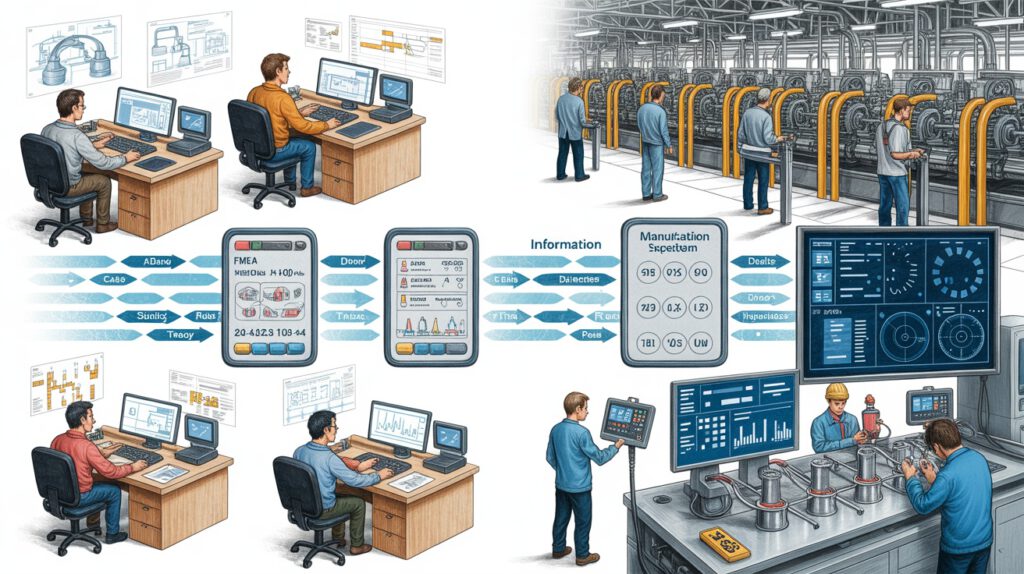
Data flow from the planning downstream to the automatically controlled series production
The last point concerns what is systematically examined in a process FMEA (P-FMEA).
The P-FMEA clarifies what is to be achieved as a result (functions with characteristics) in the individual process steps (system elements), what could potentially go wrong in the process (failure modes) , and what actions are necessary to keep the process on track (actions states with preventive and detective actions).
If production is (still) primarily manual, i.e., carried out by people in the individual steps, the actions are also primarily focused on human decisions. A “craftsman” uses tools, but automation is minimal. Human skill determines the details of the execution. Step-by-step instructions are more an obstacle than a help to create an individual product.
In manufacturing, the work steps are already divided among different experts, but are more repetitive. The result can be easily compared from product to product. This means that there are criteria that support a consistent result or allow the result to be evaluated. P-FMEA becomes relevant in such repetitive activities.
In industrial production processes, such as those found in automotive manufacturing, the food industry, but also in the pharmaceutical industry, medical technology, or the manufacture of everyday items in large quantities, the aim is to reduce the potentially negative impact of human error. Over the decades, this has given rise to techniques such as poka-yoke or automatic measurement and control.
Poka Yoke are devices that either fundamentally prevent errors from occurring or reliably detect and immediately respond to errors should they occur.
For example, the product is designed in such a way that it can only be assembled in one specific way. This prevents both incorrect assembly and mix-ups. Or there is a simple test procedure that checks a unique feature during each step or immediately after the manufacturing step. If something is wrong, the process is stopped and immediate action is taken. No error can proceed to the next step.
We are all familiar with automatic measurement and control from our home heating systems: we have a thermostat on the wall that is set to a specific temperature (setpoint). The thermostat contains a sensor, a measuring device for temperature. With a certain tolerance above and below the setpoint, the thermostat switches a signal on or off. When “on,” the heating valve opens and additional heat is allowed into the room; when “off,” the valve closes and the heat supply is interrupted. For the user, the room temperature always remains within the desired range and heat loss through doors, windows, and walls is balanced out. Something similar also happens in industrial processes—from soldering irons to blast furnaces.
How are the considerations of planning and P-FMEA incorporated into daily production processes?
In theory, the production control plan (PCP) is THE binding control document.
In practice, this is sometimes the case. In the vast majority of applications, however, the PCP is a formal stack of paper in the foreman’s office drawer, really only there to show an auditor.
The real organization of production is then controlled by separately created work instructions. And with the first digital systems, known as manufacturing execution systems (MES).
Such systems accompany the activities. They show which parts are required for the variant that is now to be assembled. And the parameters and test results were recorded digitally directly. Of course, this can only work if all activities have been prepared and preprogrammed as a sequence.
Traditionally, the PCP “belongs” to quality. The MES “belongs” to production. Two responsibilities, two worlds.
This is still the case in many companies today.
But in many ways, this is more of a problem than a help, apart from the double effort of filling two systems with the same content.
Due to the different responsibilities and manual creation, PCP and MES were and are usually not identical.
But that should be the goal: planning should reflect reality as closely as possible (keyword: digital twin) in order to provide valuable support. And planning should be the joint result of production, production engineering, logistics, maintenance/servicing, and quality. It shows optimization and, in the end, a binding decision.
And now it’s a matter of transferring this planning results into the system that gives the instructions, requests the tests, and collects the results in on-site production.
The MES combines the preventive actions during process execution with the detection actions = measurements and inspections and the reactions to errors that occur. And it is precisely these actions that should already be created and considered in the PFMEA.
Unfortunately, there is no normative specification for how the flow of information from the drawing to the P-FMEA and from there to the PCP and the implementations in the MES should take place. PFMEA and PCP are defined independently of each other. There is only the requirement that they should be consistent and free of contradictions.
But how is that supposed to work if, for example, logistics can be hidden in the P-FMEA as “non-value-adding” but significantly controls the processes in the MES?
How is that supposed to work if tests in the P-FMEA are formally designed as detection actions but no details on inspection characteristics, frequency, the test sample size, and test equipment are taken into account?
How is this supposed to work when the PCP is supposed to specify the response to errors that occur, but reaction actions do not exist in the usual P-FMEA?
Another issue that will not be discussed in detail here is special characteristics.
If you want to make the P-FMEA – PCP – MES chain consistent and free of contradictions, significantly more content must be taken into account, planned, and then transferred to the ME system in a binding manner.
Conclusions:
In the next blog post “From PFMEA to Manufacturing Execution System (MES) #2,” I will first write about how PFMEA and PCP should be linked.
Stay curious
Yours
Uwe Jarosch
Um Ihnen ein optimales Erlebnis zu bieten, verwenden wir Technologien wie Cookies, um Geräteinformationen zu speichern und/oder darauf zuzugreifen. Wenn Sie diesen Technologien zustimmen, können wir Daten wie das Surfverhalten oder eindeutige IDs auf dieser Website verarbeiten. Wenn Sie Ihre Zustimmung nicht erteilen oder zurückziehen, können bestimmte Merkmale und Funktionen beeinträchtigt werden.